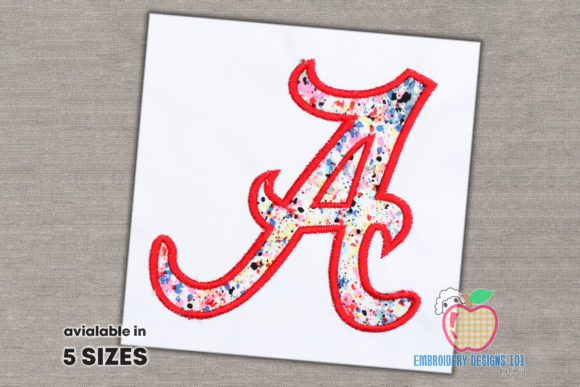
A for Alabama Design Applique
As a designer who’s stitched thousands of embroidery files—from client-branded apparel to boutique nursery sets—I opened A for Alabama Design Applique expecting something cheerful and regional, but what stood out immediately was its quiet confidence. It doesn’t shout. It leans in. The letter “A” is clean-lined and slightly rounded, with subtle Southern charm—think soft curves, balanced negative space, and just enough detail to feel intentional without overcomplicating the stitch path. It reads as both classic and contemporary, which makes it unusually versatile across real-world projects.
What This Design Feels Like in Your Hands (and on Your Hoop)
This isn’t a busy monogram or a dense floral motif—it’s an applique design, so your first instinct should be fabric layering: a base fabric, a cut piece of contrasting fabric, and clean satin-stitched edges holding it all together. That means less reliance on dense fill stitches and more emphasis on crisp edge definition. In practice, that translates to strong visual impact even at modest sizes (3–4 inches), excellent stitch clarity on medium-weight cottons and canvas, and forgiving behavior on beginner-friendly machines.
I tested it on a natural linen tote bag for a local artisan market stall—no lining, no interfacing beyond light tear-away stabilizer—and the result held up beautifully after two rounds of washing and daily use. The satin stitch border stayed smooth, the applique fabric didn’t pucker, and the overall presentation felt polished, not craft-fair-cute. That’s rare for a single-letter design meant for commercial embroidery.
Where It Shines—and Where It Asks for Thoughtful Handling
Shines:
- Custom apparel: On crewneck sweatshirts (especially heather grey or navy), the A reads clearly without overwhelming the garment. Its proportions scale well from youth small to adult XL.
- Tote bag design & aprons: Works especially well when centered above a pocket or along a side seam—adds identity without clutter.
- Baby embroidery: On organic cotton onesies or burp cloths, it feels gentle and meaningful—not too bold, not too plain.
- Embroidered patch: With proper backing and clean trimming, this design presses flat and sews on cleanly. Ideal for scout badges, boutique denim jackets, or handmade backpacks.
- Holiday embroidery & personalized gifts: Pair it with a simple “Made in Alabama” script or a tiny magnolia motif (added separately) for thoughtful, regionally grounded gifting.
Requires care:
- Stretchy fabric: Avoid direct application on knits like jersey or ribbed t-shirts unless you use cutaway + topping combo and reduce stitch density manually—if your machine allows.
- Curved surfaces (caps/hats): The shape works, but test hoop placement first—the top curve may need slight repositioning to avoid distortion.
- Thin or delicate fabrics: Silk, chiffon, or lightweight rayon need ultra-light stabilizer and possibly a basting stitch before applique placement.
- Dense stitch areas: Though not overly complex, the inner curve of the “A” has tighter satin stitching—watch for thread nesting if using low-quality thread or skipping stabilizer.
How It Shapes Perception—Before and After Stitching
Customers don’t buy letters. They buy meaning, memory, and belonging. When I added A for Alabama Design Applique to a set of hand-embroidered tea towels for a Birmingham-based kitchen shop, buyers consistently commented on how “thoughtful” and “grounded” the pieces felt—even though it was just one letter. That’s the power of intentional design: it signals care, place, and personality without needing explanation.
For Etsy sellers and small shop owners, this design quietly elevates perceived value. It reads as professional-grade—not generic clip art—so your finished product gains credibility. For craft business owners bundling digital embroidery files, it pairs naturally with state-themed collections (though note: despite the name, this design belongs to U.S. regional identity—not South America—so ensure your category tags reflect that accurately).
Practical Designer Notes You’ll Actually Use
Before sending A for Alabama Design Applique to your machine—or listing it as part of a digital product bundle—do these five things:
- Test on scrap fabric first, using your exact thread colors and stabilizer combo. Watch how the satin stitch behaves on your chosen base fabric—especially near corners.
- Check thread color contrast. Light thread on dark fabric? Dark thread on light? Some satin stitch designs lose definition if contrast is too low—this one holds up well, but verify.
- Review stitch density in your embroidery software. If you’re layering it over another design or adding text, make sure overlapping areas won’t create unintentional bulk.
- Confirm hoop size compatibility. While it’s adaptable, very small hoops (under 4” x 4”) may require resizing—always check the original dimensions before scaling down.
- Inspect small details in black-and-white mockups. Does the A remain legible when reduced to grayscale? Does it retain character on dark backgrounds? This helps with printable mockups and digital previews.
And one final note: A for Alabama Design Applique comes with multiple embroidery file formats and color-separated steps—great for multi-thread workflows—but always double-check licensing terms before selling finished items or bundling it into digital embroidery kits. Commercial use permissions vary, and clarity here protects your craft business long term.
Final Thought: A Letter That Carries Weight
This isn’t just another machine embroidery design. It’s a quiet anchor—a recognizable, respectful nod to place that works equally well on a baby’s onesie, a chef’s apron, or a limited-run tote for a local bookstore. It doesn’t try to do everything, and that’s why it does so much well. Whether you’re building design assets for your Etsy shop, prepping for a craft fair season, or sourcing embroidery project ideas for clients, A for Alabama Design Applique earns its spot in your working library—not because it’s flashy, but because it’s trustworthy, adaptable, and thoughtfully built for real fabric, real machines, and real people.